Laboratories and scientific groups
Aluminosilicate Rock Processing and Inorganic Polymers Laboratory
Works on chemical processing of rocks, microwave synthesis, and production of functional silicate materials.
Overview
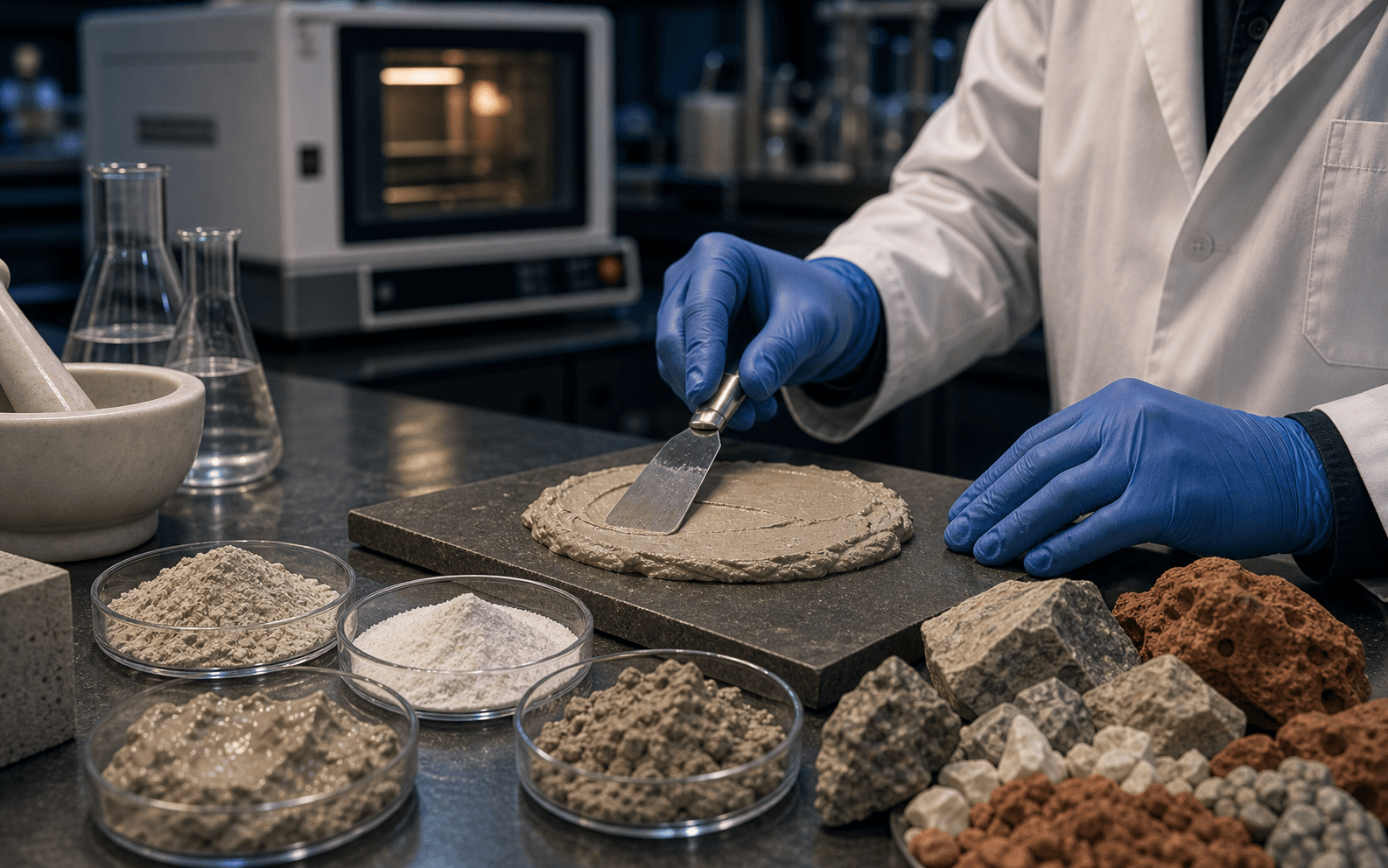
Since 1957, the laboratory has carried out research on improving hydrothermal processing methods for rocks—nepheline syenite, perlite, diatomite, tripoli, quartzite, dolomite, limestone—and developing new approaches for obtaining alumina, silicates, and composite materials. From its foundation until 2013 the laboratory was headed by S. Yengibaryan, Candidate of Technical Sciences; since 2013 it has been headed by V. V. Baghramyan, Candidate of Technical Sciences.
Technologies have been developed for obtaining liquid glass, silicon dioxide, crystal glass, optical and ceramic paints, thermoregulatory coatings, radiation-protective materials, and materials with other unique properties; these technologies have been tested and introduced at different factories. The laboratory was among the first in Armenia to work in microwave chemistry. Doped silicates have been obtained whose crystallization occurs at temperatures 150–200°C lower than usual. A microwave method for obtaining silicate paints and zircon pigments has been developed. The ISTC-funded A-2133 project was carried out.
The main scientific direction of the laboratory is the chemical processing of rocks by converting the silica and other inorganic elements contained in them into soluble compounds and obtaining valuable new materials on that basis.
To achieve these goals, new methods have been and continue to be developed to improve and replace costly traditional methods. In particular, the laboratory has developed a new microwave method for obtaining silicate materials, and over the last fifteen years most research has focused on developing optimal conditions for obtaining pure silicates, functional materials, composites, pigments, glass batches, special ceramics, and other materials by this method, producing experimental samples, and studying the obtained materials.
Within the current basic research topic, the laboratory studies the influence of microwave radiation on the mechanism of obtaining functional materials in yttrium silicate, aluminate, and Y2O3-Al2O3-SiO2 systems, and develops a new microwave method to reduce energy costs and improve the physicochemical properties of these materials.
Within thematic funding (Topic 21T-1D146, “Microwave synthesis of composite materials with photocatalytic properties”), a new microwave method for obtaining zinc silicate composites with photocatalytic activity has been developed.
Current research is directed toward obtaining materials with special properties from silica-containing rocks such as perlite, diatomite, and quartzite by the microwave method, including development of microwave synthesis for a new class of active silicate photocatalysts, materials with piezoelectric properties, radiation-resistant and radiation-protective materials, and ceramic pigments. The laboratory closely cooperates with the University of Modena (Italy), the University of Notre Dame (USA), the Alikhanyan National Laboratory, the Institute for Physical Research, the Institute of Chemical Physics, Yerevan State University, and the National Polytechnic University of Armenia.
As a result of these collaborations, more than 30 articles have been published and the laboratory has participated in scientific conferences.
Leader
Վոլոդյա Բաղրամյան
Research areas
Related people
Վոլոդյա Բաղրամյան
Head of laboratory