Laboratories and scientific groups
Aluminum-Bearing Natural Raw Materials and Industrial Waste Processing Group
Studies processing of minerals, concentrates, and industrial waste to solve environmental and technological problems.
Overview
From its foundation in 1968 until 2003, the Laboratory for Neutralization of Industrial Waste was headed by S. Karakhanyan, Doctor of Technical Sciences; from 2003 to 2020 by S. Saharunyan, Candidate of Technical Sciences; from 2020 to 2025 by E. Nazaryan, Candidate of Technical Sciences; and since 2026 it has operated as a group.
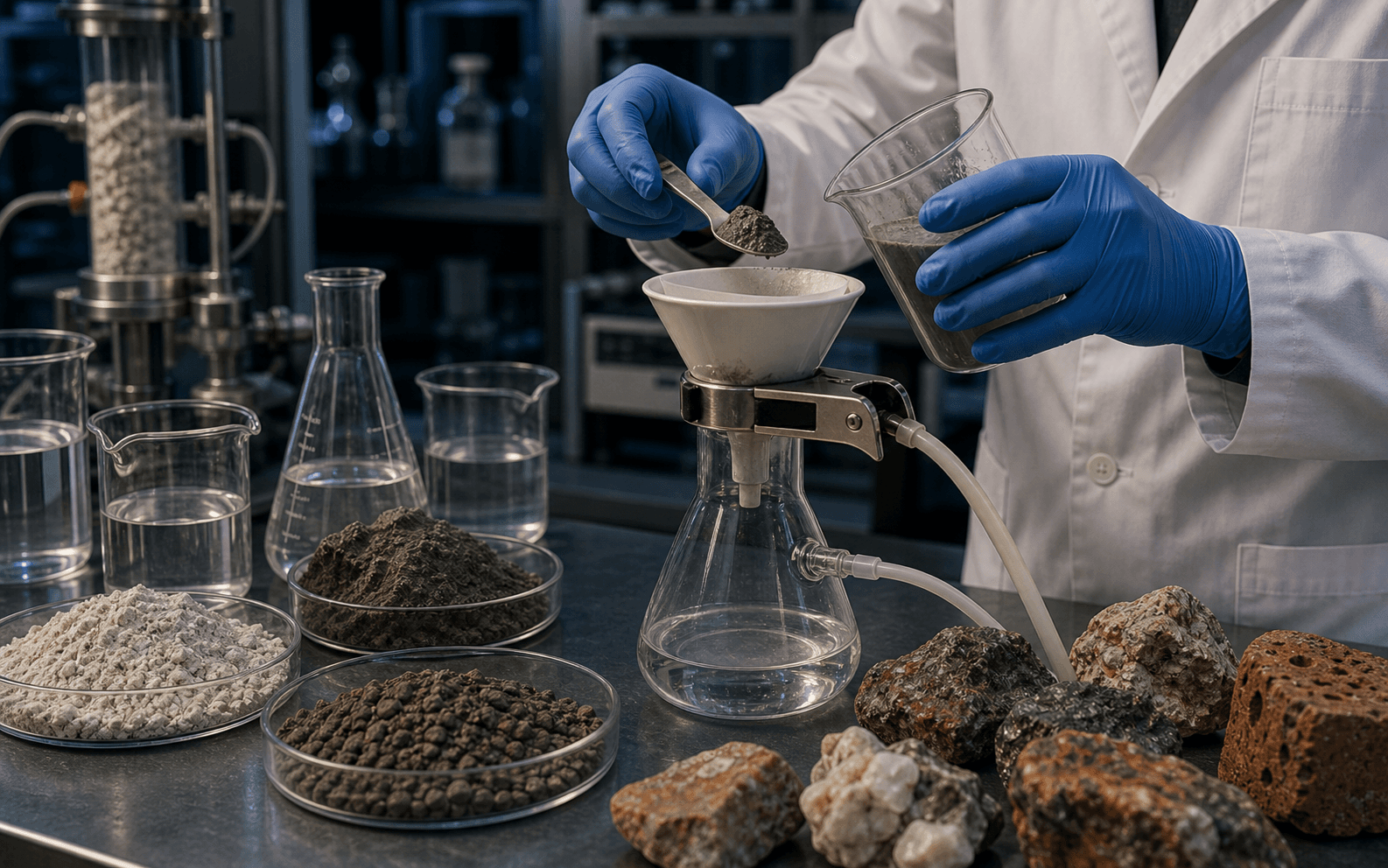
The laboratory has worked on processing and recycling industrial concentrates, waste, and minerals in Armenia. Among its activities were design of a closed-loop industrial-water system for the Hrazdan Mining-Chemical Combine; absorption of fluorine gases at the Kanaz aluminum plant; production of bricks from dust accumulated in electrofilters in cement production, introduced at the Novorossiysk cement plant; treatment of industrial wastewater at the Shahumyan silk combine; organization of table-salt production using brine in the area of the Avan salt mine and thermal power plant; development of the Yeghegnadzor quartzite mine at an experimental plant to obtain raw material for glass production, introduced at the Yerevan electric lamp plant; and enrichment of aluminum-poor raw materials such as nepheline syenite, synnyrite, perlite, and others by an acid-base-acid method. The work continues.
Armenia has rich copper and molybdenum deposits. The country has about 19 tailing dumps formed by the activity of copper-molybdenum and other enterprises, creating environmental problems whose processing is of great importance for the economy and environmental protection.
The following work is being carried out.
• Extraction of copper and molybdenum from waste of the Kajaran copper-molybdenum combine by a hydrometallurgical method (heap leaching) at low temperatures (15–35°C) using an environmentally clean approach.
• Processing of molybdenum concentrate with sodium hydroxide.
• Production of building materials using different wastes, including cement dust, tuff dust, and glass fragments; as a result, partition tiles have been obtained, among other products.
Leader
ք.գ.թ. Էդիտա Նազարյան
Research areas
Related people
Էդիտա Նազարյան
Group leader, PhD in Chemistry