Laboratories and scientific groups
Applied Materials from Basic Rocks Laboratory
Synthesizes and studies silicate ceramics, pigments, and luminescent materials from local serpentinite-derived raw materials.
Overview
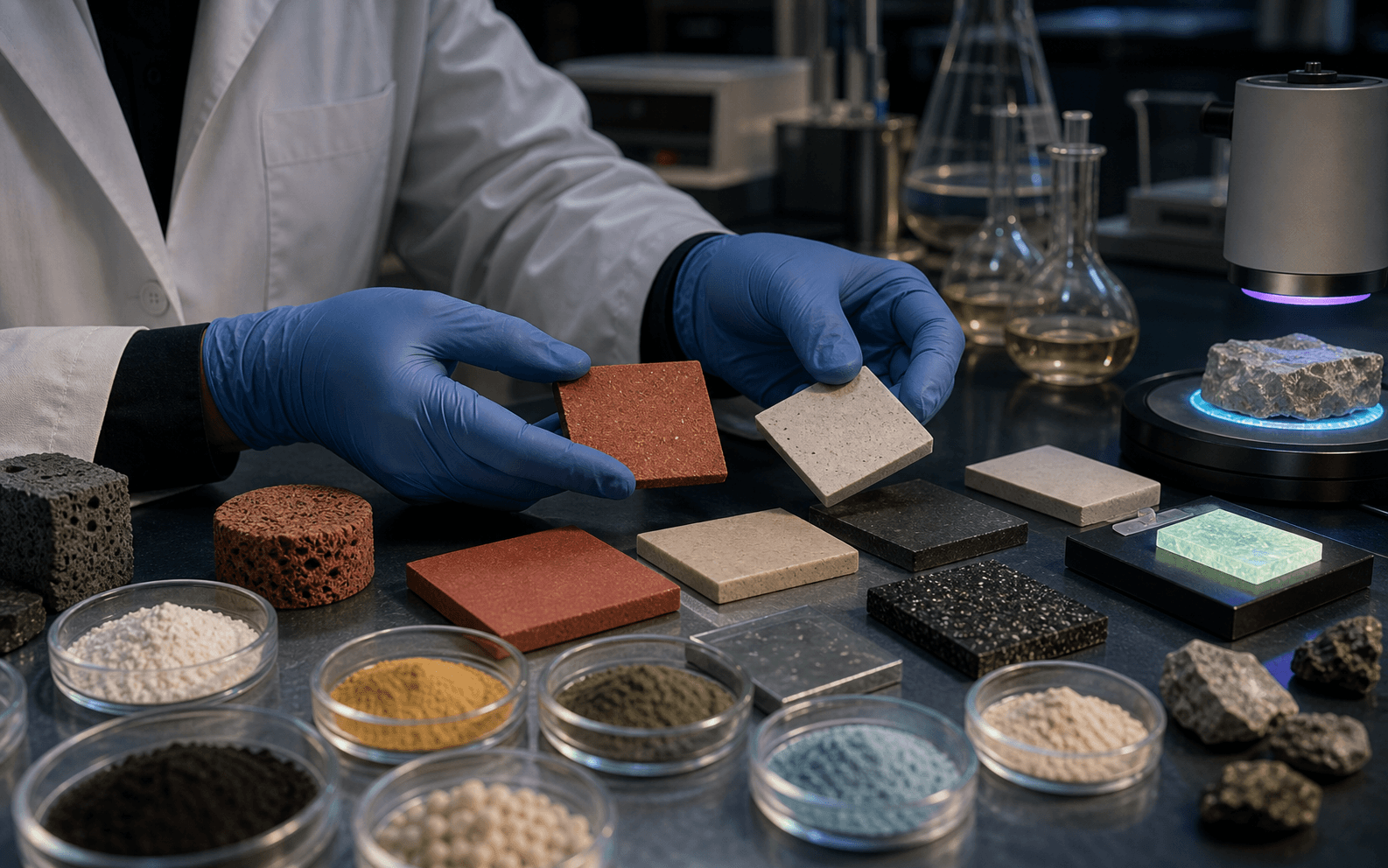
The Laboratory for Obtaining and Studying Applied Materials from Basic Rocks was established in 2023. Its goal is to synthesize silicate ceramics, pigments, luminescent materials, and other materials of practical significance from a “nontraditional” type of silicon dioxide obtained from local serpentinite raw materials, (Mg(Fe))6[Si4O10](OH)8, and to develop effective approaches for their study and synthesis.
Taking a distinctive approach to routes for obtaining refractory silicate compounds, the group has carried out a number of grant projects: two youth-support programs (13YR-1D0005, 16YR-1D025), laboratory creation (21SCG-1D013), a thematic project (21T-1D131), and laboratory strengthening (21SCG-1D013).
A more efficient and environmentally safe method has been developed for obtaining difficult-to-synthesize silicate pigments, making it possible to produce market-competitive silicate pigments. For example, a new methodology was developed for willemite-based silicate pigments, Zn2-xCoxSiO4 (blue, x=0.01–0.5) and Zn2-xNixSiO4 (sky blue, x=0.1–0.4; green, x=0.5–2.0), using hydrosilicagel derived from serpentinites. For the first time, at low temperatures of 900–1100 °C under one-hour heat treatment, a precipitation method enabled a high yield of the difficult-to-synthesize nickel silicate Ni2SiO4, reaching 94–98%. The resulting pigments were tested in different glazes; their thermal stability during heating, interaction with the glaze matrix, and final color properties after firing were studied.
Numerous tests showed that heat treatment at 1100 °C of intermediate compounds precipitated at room temperature in the SiO2·nH2O–NaOH–BaCl2–Eu(NO3)3 system forms a new luminescent material with the composition NaBa6Eu(SiO4)4, which exhibits pink luminescence under ultraviolet radiation. This material has strong potential for practical use in various technological and scientific fields.
The laboratory closely cooperates with local and foreign scientific centers, including Sapienza University of Rome and the Grebenshchikov Institute of Silicate Chemistry of the Russian Academy of Sciences. More than 20 scientific works have been published and indexed in Scopus.
Leader
ք.գ.թ., դոցենտ Հ.Ա. Բեգլարյան
Research areas
Related people
Հայկ Բեգլարյան
Head of laboratory, PhD in Chemistry, Associate Professor