Laboratories and scientific groups
Heterophase Chemical Processes Research Group
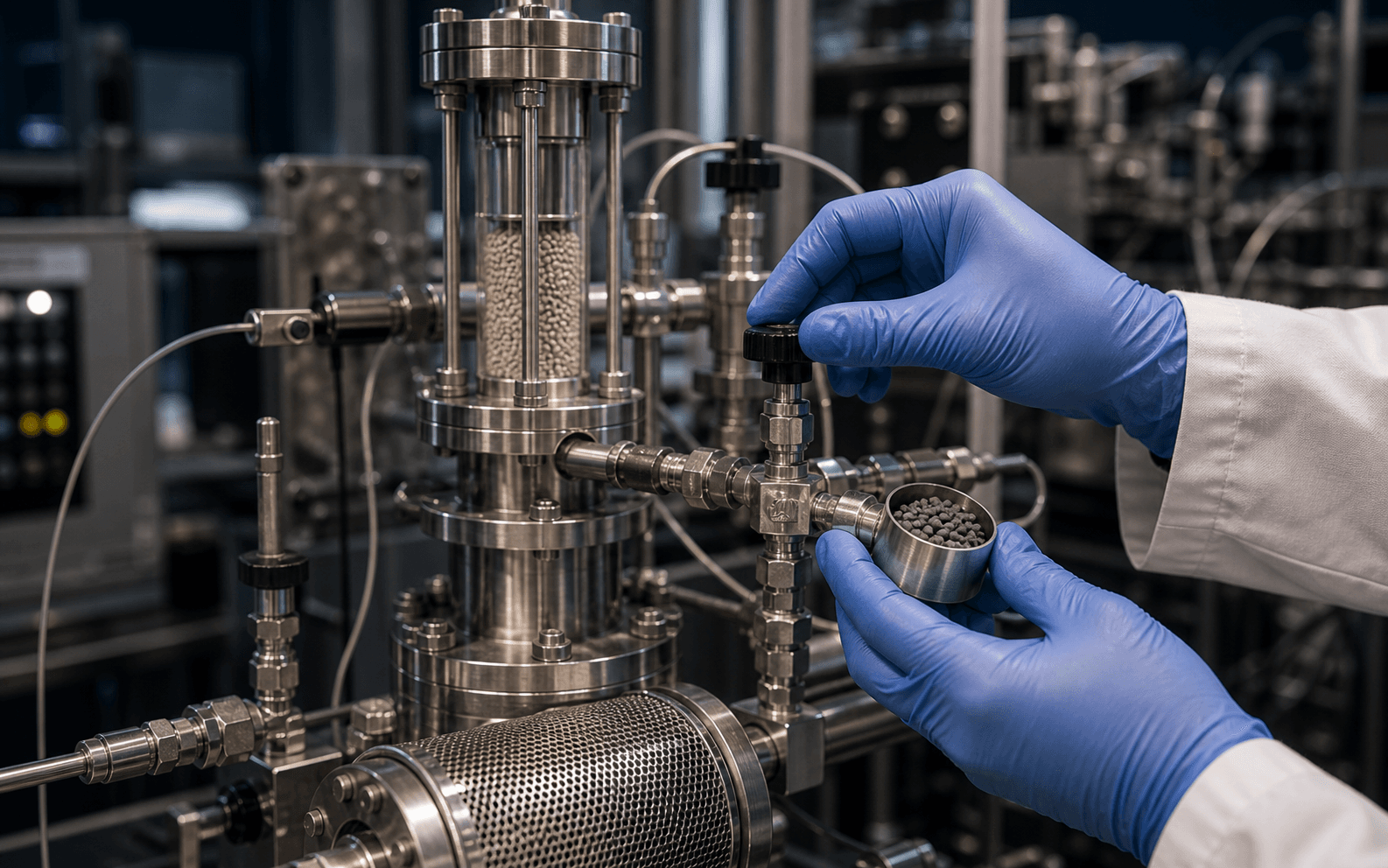
Studies directed transformations of inorganic materials and catalytic systems under gas-phase chain-reaction activation.
Overview
In 2005, a laboratory was founded at the joint scientific-educational base of the State Engineering University of Armenia and the Institute of Chemical Physics of the National Academy of Sciences of Armenia. Since 2011 it has operated within the Institute of General and Inorganic Chemistry. Since its establishment, the scientific supervisor and head has been K. Mantashyan, Candidate of Chemical Sciences. Since 2026 it has operated as a group.
The research is based on a new principle developed in Armenia for heterophase chemical transformation processes of various inorganic compounds and materials under the influence of gas-phase chain reactions (chain-reaction activation processes). This principle also enables processes that are difficult to carry out using conventional chemical methods.
The method has enabled highly efficient, directed-selective radical-chain chemical transformations of inorganic materials of different classes and structures, as well as synthesis of materials with new properties. During this type of coupled heterophase process, atoms and free radicals continuously generated in sufficient concentrations actively enter into various reactions with solid-phase compounds at low activation energy, simultaneously creating new active centers and thereby ensuring homogeneous-heterogeneous chain-reaction processes at high conversion rates and significantly lower temperatures.
The fundamentally new approach under development has been tested on numerous examples. The scientific results show that sulfides, sulfates, chlorides, and oxides of different metals (Cu, Fe, Mo, Ti, Pb, Zn, Al, Re), as well as natural non-metallic mineral silicate raw materials such as quartzites, perlites, zeolites, and dunites, undergo efficient one-stage transformation. Under chain-reaction activation, it becomes possible to obtain compounds and materials with new advanced properties. The data indicate that, depending on the parameters of the activation regime, amorphous and nanosized particles, incompletely ordered crystal-lattice formations, nonstoichiometric compounds, states with paramagnetic properties, and other forms may arise during the process. Materials of this type have high chemical activity.
The available fundamental and technological achievements currently make it possible to propose the following practical methods for solving important applied problems using the chain-reaction activation method.
1. Modern efficient heterophase processes for processing important natural sulfide minerals and concentrates of Armenia—molybdenite MoS2, chalcopyrite CuFeS2, pyrite FeS2, sphalerite ZnS—as well as metallurgical waste slags, with formation of elemental sulfur (S), economically and energetically advantageous operation, environmental safety, and production of valuable final products and compounds with new properties.
2. A fundamentally new method for obtaining directed catalysts of a new type and quality with high selectivity, intended for use in gas-phase chain reactions of oxidation of industrially important hydrocarbons.
Leader
ք.գ.թ. Կորյուն Մանթաշյան
Research areas
Related people
Կորյուն Մանթաշյան
Scientific leader, PhD in Chemistry