Laboratories and scientific groups
Mineral Salts Laboratory
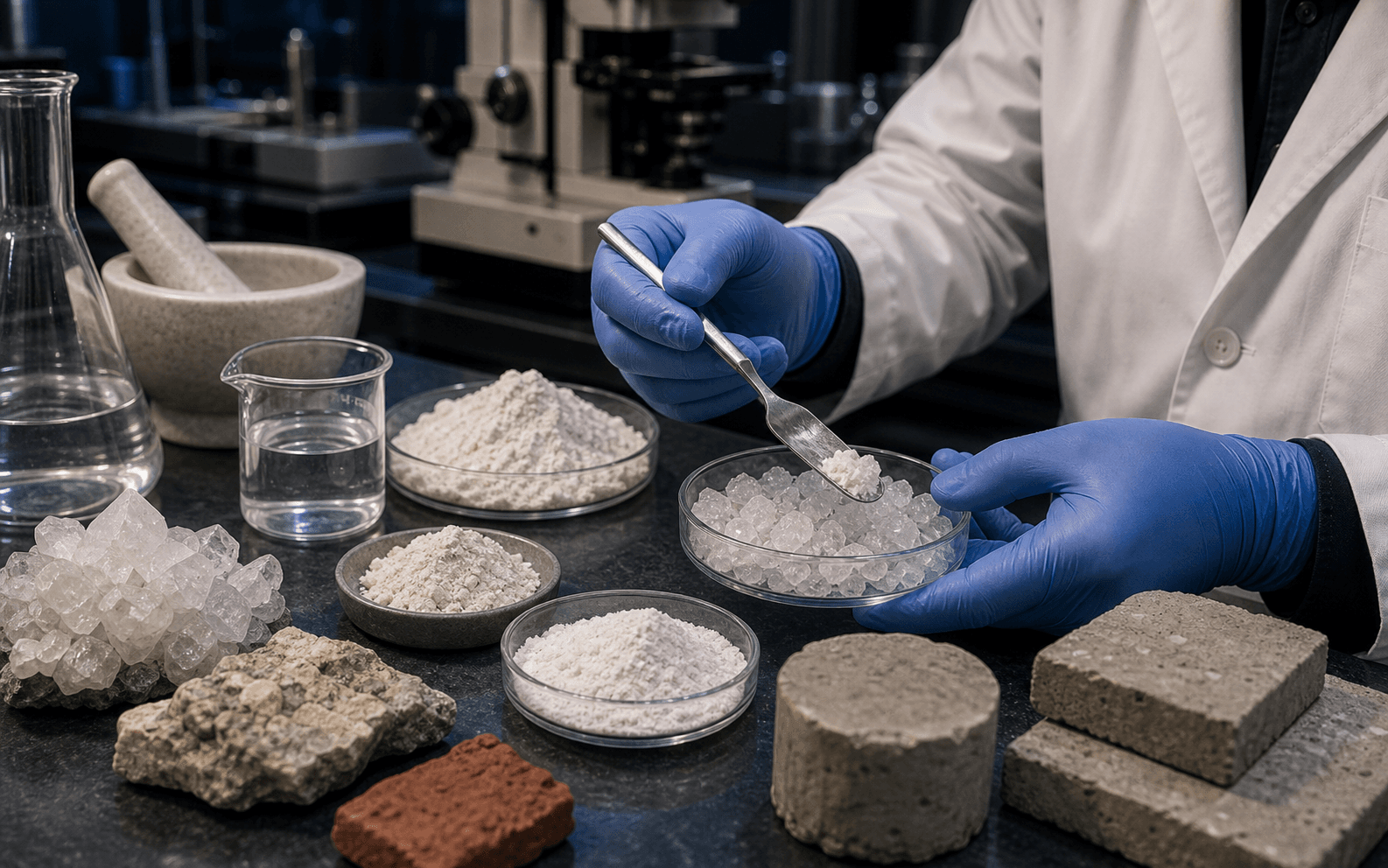
Develops technologies for mineral salts, phosphogypsum, fertilizers, wollastonite, and cement additives.
Overview
The Mineral Salts Laboratory was founded in 1957 and became involved in work on obtaining alumina from nepheline syenites under the leadership of G. Grigoryan, Candidate of Technical Sciences.
The laboratory developed methods for drying and granulating phosphogypsum, processing phosphogypsum into other materials such as cement and sulfuric acid, and obtaining a high-strength binder (α-gypsum). These works were introduced at chemical plants in Voskresensk, Uvarovo, Gomel, Sumy in Ukraine, and Wizów in Poland.
Work on obtaining wollastonite by low-temperature technology continued with the production and implementation of jewelry mold materials based on wollastonite at the Yerevan jewelry plant under ISTC project A-714. A method and technology for obtaining roof tiles from Armenian clays were developed.
Since 2013, work on developing a method and technology for obtaining slow-release fertilizers from potassium aluminosilicates has continued under the leadership of laboratory head K. Grigoryan, Candidate of Technical Sciences, within ISTC project A-2196.
Research is being carried out to obtain fertilizers containing P, Fe, amorphous silicon dioxide, and other important nutrients from local nontraditional raw materials, particularly Sisian diatomaceous rocks. A waste-free and low-cost method for producing fertilizer has been proposed. The physicochemical properties of the obtained fertilizers were studied, and agrochemical tests showed high efficiency compared with a simple mixture of double superphosphate, iron sulfate, and silicon dioxide. The fertilizer has slow and prolonged action and can be used in conventional and organic agriculture. Work is underway to improve the method and determine application rates and timing.
The transformation of nutrients contained in widely distributed Armenian serpentines into plant-available forms during acid treatment is also being studied. In addition to nutrients contained in serpentinite raw materials, particularly Mg, Fe, Si, and others, the resulting fertilizer may also contain S or N depending on the acid used. According to agrochemical tests, the obtained fertilizer is competitive with analogues.
It is also very important that the raw material is accessible and may include waste from other productions, such as serpentinite, sulfuric acid, or a mixture of sulfuric and nitric acids, thereby supporting increased production volumes, for example at ARIAK CJSC. Work is planned to improve the method and technological solutions and to carry out large-scale agricultural tests.
Replacing part of cement with mineral additives is important from engineering, environmental, and economic perspectives. The effects of cement mixing methods, target additives, and different fillers on cement strength and structure are being studied. Work on improving the properties of cement materials continues, particularly through the use of nanosized fillers, and preliminary results are positive. A new approach aimed at obtaining cement-based sensor materials is also being studied; this is a modern and rapidly developing field.
Leader
տ.գ.թ. Կարեն Գրիգորյան
Research areas
Related people
Կարեն Գրիգորյան
Head of laboratory, PhD in Engineering